
Dominate One Segment, Then Expand
Chasing multiple customer segments feels like the safe bet. It's usually the reason deals stall. Geoffrey Moore's advice from Crossing the Chasm still works - here's why, and how to apply it.
The Problem: Too Many Segments, Not Enough Traction
If you’re a deep tech founder with genuine demand from multiple markets, the instinct to chase all of it makes sense. More segments feels like more revenue, less risk, more defensibility. It’s also why excitement without focus leads to stalled traction.
I recently worked with a hardware startup pursuing three different verticals across three geographies. Three segments, three buying processes, three pain profiles. Zero closed deals.
“We can’t afford to turn away customers who are coming to us. We need every deal we can get right now.”
The co-founder wasn’t wrong to see opportunity everywhere - there WAS demand from multiple markets. But chasing all of it was preventing them from winning any of it.
The Solution: Focus on One Beachhead
Geoffrey Moore nailed this problem in his 1991 Crossing the Chasm. His advice still works:
- Focus on one customer segment (he called it a beachhead)
- Dominate that segment, then expand to the next
- Do not set expansive sales goals until you have truly secured the beachhead
Why Focus Works: Word of Mouth Requires Reference Groups
Word of mouth is the most powerful way to grow a product. But it only works if you’re selling to customers who reference each other - who are willing to give and receive referrals within the same community.
If you sell to pharma one week and industrial manufacturing the next, the industrial buyer isn’t going to care what the pharma buyer says. You’ve broken the reference loop.
Here’s the test I use with founders: do the customers you’re selling to in market A talk to the customers in market B? Do they attend the same conferences? Read the same trade press? Feel impacted by the same industry forces? If not, they’re not the same segment - they’re different markets wearing the same label.
We applied this test to that hardware startup. Their three segments didn’t share events, supply chains, or trade press. They weren’t one market - they were three.
Your ICP Should Be Narrower
We now call Moore’s beachhead an Ideal Customer Profile (ICP). Founders who define theirs too broadly see slower sales and feature bloat that reduces value delivery for everyone.
Want to find product-market fit faster? Narrow your target market past the point that feels comfortable.
Moore’s Original Insight
Moore explained it perfectly:
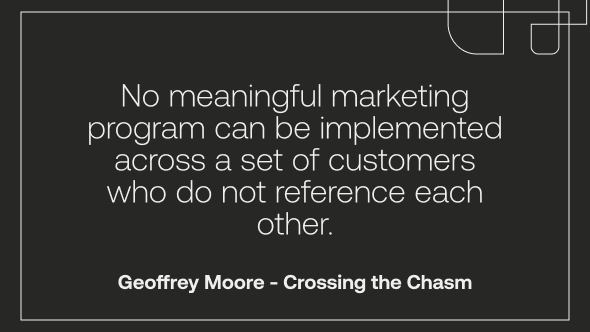
“Marketing professionals insist on market segmentation because they know no meaningful marketing program can be implemented across a set of customers who do not reference each other. The reason for this is simply leverage. No company can afford to pay for every marketing contact made. Every program must rely on some ongoing chain-reaction effects - what is usually called word of mouth. The more self-referencing the market and the more tightly bounded its communications channels, the greater the opportunity for such effects.”
What This Looks Like in Practice
At VECTOR, one of the first things we do with founders is narrow. We look at all the segments they’re pursuing and eliminate the ones that don’t reference each other or require meaningfully different product and messaging. This feels counterintuitive - especially when you’re pre-revenue and every deal feels critical. But a narrower focus compounds: your messaging sharpens, your references stack, and each deal makes the next one easier to close.
That hardware startup picked one segment and set a hard validation deadline - setting measurable goals for beachhead validation matters here. Within four weeks, they needed three or more buyers who had the pain and were willing to pay. If validated, double down. If not, pivot to the next segment. It wasn’t “give up on other markets forever” - it was “validate one thing first, then expand with a proven playbook.”
In 6 months, the goal is 10 real customers in one focused segment. Not 50 pilots across five industries that never convert.
The Beachhead Test
Ask yourself:
- Do my current customers reference each other? Would they attend the same conferences, read the same publications, talk to each other?
- Can I name 3 customers who bought for the same reason, in the same segment?
- Would my current customers give a reference to someone just like them?
If the answer to any of these is no, you don’t have a beachhead yet. You have a list.
Drowning in conflicting advice while your runway burns? At VECTOR, we help founders turn scattered sales efforts into a repeatable GTM engine - starting with a hard focus on the right beachhead. Apply to work with us - or read how to identify your customers’ burning needs as the foundation for ICP definition.